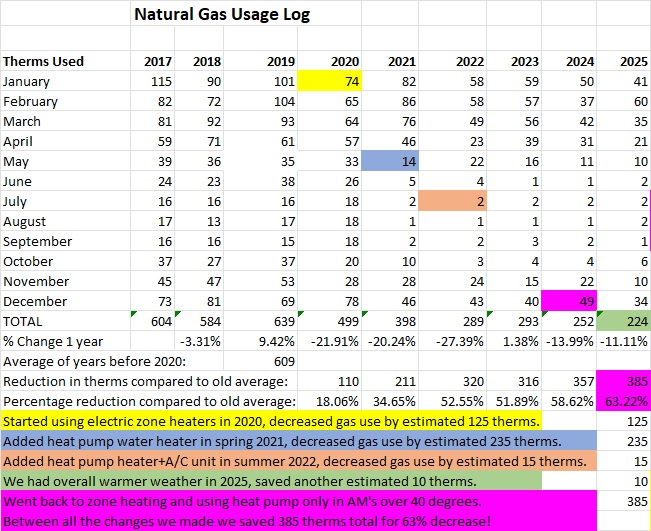
We started our heat pump journey with a hot water heater in April 2021, followed by a heat pump HVAC system in June 2022, and a master bedroom mini-split in June 2023. The main goals of these systems are to (1) reduce carbon emissions by using the solar we produce on our roof to efficiently heat and cool our home and produce hot water and (2) keep us comfortable in the areas of the house we use.
We’ve had these systems for a few years now and have learned a lot through experience. We have definitely accomplished our goals, but we use some of the systems differently than we anticipated and there is one system we would not purchase again for our particular home.
Here’s a little summary table of our systems:
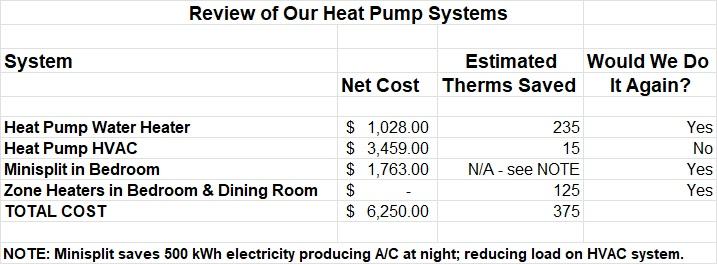
The heat pump water heater is definitely our star! It cost the least and saves the most natural gas-235 therms. It works beautifully and even helps cool our garage in the summers (it puts the heat from the air into the water). We would definitely do it again!
The heat pump HVAC was our only disappointment. We had thought it would save electricity over our electric zone heaters, but it didn’t. Essentially we learned that it is not efficient at temperatures below 40 degrees. We originally set the heat pump to run at 35 degrees and above. We discovered we were using a lot of electricity and it was running all the time when it was cold. In milder temperatures, it works well to keep the whole house warm at a steady temperature. However, that uses more electricity than our zone heaters because the HVAC is a bigger unit and uses more power. We don’t use our whole house, staying mostly in the front rooms during the day which are farthest from the HVAC unit. We always felt a little chilly in those areas, so we ended up using our Zone heaters some in addition to the heat pump. This ate up about 1 megawatt of electricity that we are now saving by just using the Zone heaters. Now we use the heat pump HVAC only when temperatures are above 40 degrees to do the morning lift, mostly during shoulder seasons. (We turn down our thermostat to 62 at night and raise it to 68 when we get up.) This saves us about 15 therms of gas, so not enough to justify getting a heat pump again. We use it for A/C in the summer months during the day to cool the house, but at night we switch to the minisplit in our bedroom. In hindsight, we would have just replaced our old A/C unit with a newer one rather than getting the heat pump HVAC. In talking with our neighbors, they use their heat pumps a little differently than we do (see HVAC blog link below). Each situation is different and heat pumps can be the way to go, depending on the household.
The minisplit in our bedroom we use during hot summer nights to keep us cool and drown out the drag racing on the ring road near our home. It makes a lovely white noise and keeps us cool, while saving about 500 kWh of electricity over what we used to use when we had the HVAC cooling the whole house at night. Now that unit doesn’t run at all at night, except if we have company and want to keep them cool.
The Zone heaters are not heat pump technology, but efficient electric space heaters. We use an EdenPURE infrared copper heater in our dining room area during the day. Many days we don’t need it in the later afternoon. It keeps the area I work in at the dining room table and our kitchen warm, but the open design of our home means it also adds heat to the living room where Scott works. There is a Lopi gas stove in the living room, which I use in the mornings for my practice and we use in the evenings until we head to bed to read. It also holds the house at 62 degrees overnight so the main HVAC doesn’t come on at night-it only does the morning lift to 68 degrees. We use a Dyson heater in our bedroom when we are reading at night and it is chilly; Scott uses it in the mornings when he is reading while I’m doing my practice. We already had the Zone heaters, so they didn’t cost us anything and save us about 125 therms of gas. We have learned that zone heating and cooling is the way to go in our house, given how we use it.
Carbon and Cost Savings
Each therm of natural gas produces 12 pounds of CO2. So saving 385 therms saves 4,600 pounds of CO2. We pay about $0.50 per therm on average, so it saves about $193 per year off our NV Energy bill. We have decreased our gas use by 63%.
NOTE: It does take a lot of electricity to power these units and that is worth considering before installing them. Our household electricity usage has almost doubled, going from 6800 kWh annually to 13,500 kWh, a 6,700 kWh increase. Our solar panels generate the electricity we use for our household so it doesn’t cost us extra and reduces our carbon footprint. If we didn’t have the panels, we would be paying about $544 more per year (1 kWh=$0.11: 6700 kWh increase in electricity use X $0.11=$737-$193 gas savings=$544). We would also have increased our carbon footprint by 4,100 pounds (1 kWh=1.3 pounds: 6700X1.3=8,700-4,600 pounds saved in gas= 4,100). It really works best to use these systems in conjunction with solar panels.
Overall, we are very pleased with our systems and both agree we are now more comfortable in our home than we were before making these changes, plus we are saving both carbon and money!
For more detailed information about our heat pump systems–how they work, the installation process, cost breakdowns, how we and our neighbors use them, see these previous posts which have been updated:
Heat Pump Hot Water Heater: https://rhondaashurst.com/2021/04/25/our-new-hybrid-heat-pump-water-heater/
Heat Pump HVAC: https://rhondaashurst.com/2023/03/03/our-new-hybrid-split-heat-pump-system/
Mini-Split: https://rhondaashurst.com/2024/03/11/our-mini-split/